Lte Slot Symbol
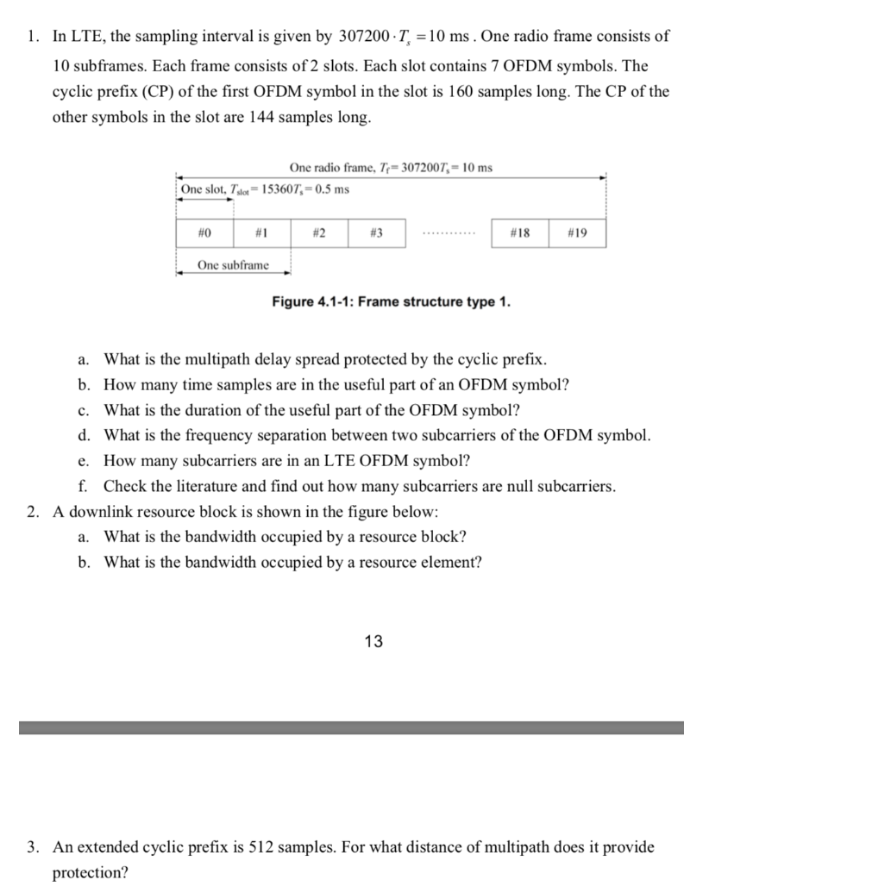
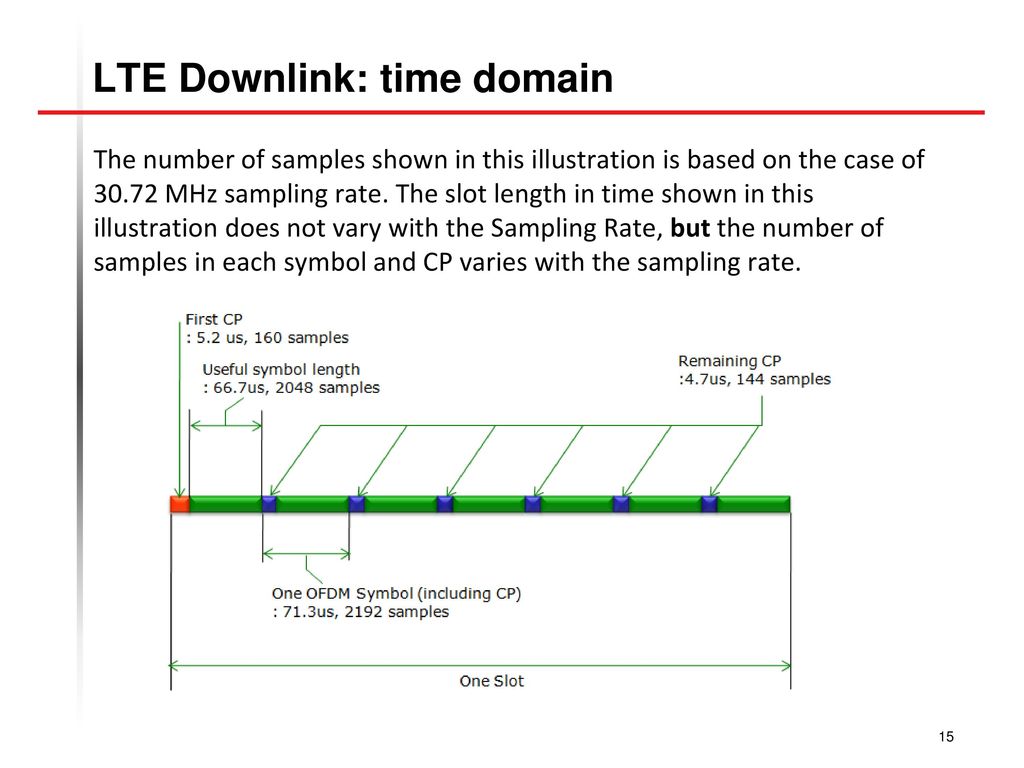
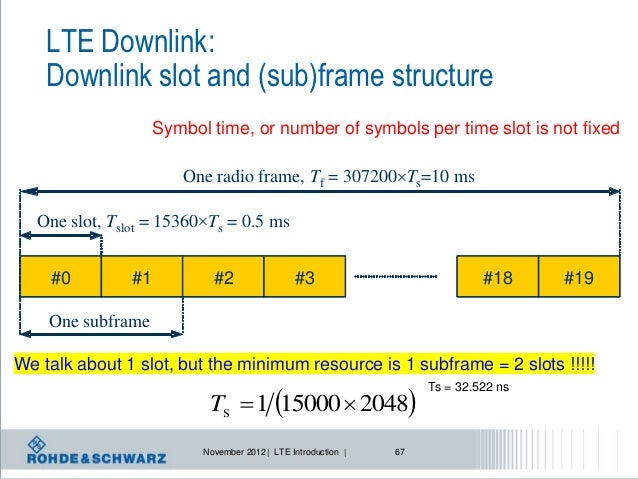
Frame Structure The following figure shows the frame structure of an LTE signal (FDD) In the time domain, one LTE frame has a 10 ms period and consists of 20 slots of 0 5 ms each A subframe is defined as two consecutive slots 50 Resource Blocks 7 Symbols RB = 12 Sub-carriers x 7 Symbols 12 Subcarriers 0 49 (normal) Slot (10MHz) = 50 RB. In LTE FDD and LTE TDD, the cell-specific reference signal is transmitted in the first and fifth symbols of each downlink slot. It occupies two of every 12 subcarriers in the single antenna case, and four of every 12 subcarriers if more transmit antennas are used. LTE frame is divided based on time slots on time axis and frequency subcarrier on frequency axis. Resource block is the smallest unit of resource allocation in LTE system. It is of about 0.5ms duration and composed of 12 subcarriers in 1 OFDM symbol.
There are two types of frame structure in the LTELong Term Evolution standard, Type 1 and Type 2. Type 1 uses Frequency Division Duplexing (uplink and downlink separated by frequency), and TDDTime Division Duplex: A duplexing technique dividing a radio channel in time to allow downlink operation during part of the frame period and uplink operation in the remainder of the frame period. uses Time Division Duplexing (uplink and downlink separated in time). This overview covers both LTE FDDFrequency Division Duplex: A duplex scheme in which uplink and downlink transmissions use different frequencies but are typically simultaneous. Type 1 signals and LTE TDD Type 2 signals described in the standard documents listed in the About Opts BHD and BHE: LTE Modulation Analysis topic.
This overview is not an exhaustive description of the physical layer, but is intended to provide you with a useful background when you configure the 89600 VSA LTE demodulator to make measurements.
For a more in depth explanation of LTE, see the 3GPP Long Term Evolution: System Overview, Product Development, and Test Challenges application note. Keysight has also released a book called LTE and the Evolution to 4G Wireless: Design and Measurement Challenges which contains detailed information on many of the aspects of LTE.
Terminology
First, an introduction to some of the terms used in describing an LTE Frame. There are six time units: frame, half-frame, subframe, slot, symbol, and the basic time unit (Ts), as shown in the following table.
Time Unit | Value |
|---|---|
| Frame | 10 ms |
| Half-frame | 5 ms |
| Subframe | 1 ms |
| Slot | 0.5 ms |
| Symbol | (0.5 ms) / 7 for normal CP1) Contention period, or 2) Cyclic prefix (0.5 ms) / 6 for extended CP |
| Ts | 1/(15000 * 2048) sec » 32.6 ns |
Below is an illustration of an FDD frame.
A resource block (RBResource Block) is the smallest unit of resources that can be allocated to a user. The resource block is 180 kHzkiloHertz: A radio frequency measurement (one kilohertz = one thousand cycles per second). wide in frequency and 1 slot long in time. In frequency, resource blocks are either 12 x 15 kHz subcarriers or 24 x 7.5 kHz subcarriers wide The number of subcarriers used per resource block for most channels and signals is 12 subcarriers.
The 89600 VSA LTE demodulator currently only supports resource blocks that are 12 subcarriers wide.
Frequency units can be expressed in number of subcarriers or resource blocks. For instance, a 5 MHzMegahertz: A unit of frequency equal to one million hertz or cycles per second. downlink signal could be described as 25 resource blocks wide or 301 subcarriers wide (DC subcarrierIn an orthogonal frequency division multiplexing (OFDMOrthogonal Frequency Division Multiplexing: OFDM employs multiple overlapping radio frequency carriers, each operating at a carefully chosen frequency that is Orthogonal to the others, to produce a transmission scheme that supports higher bit rates due to parallel channel operation. OFDM is an alternative tranmission scheme to DSSS and FHSS.) or orthogonal frequency division multiple access (OFDMA) signal, the subcarrier whose frequency would be equal to the RFRadio Frequency: A generic term for radio-based technologies, operating between the Low Frequency range (30k Hz) and the Extra High Frequency range (300 GHz). center frequency of the station. is not included in a resource block).
The underlying data carrier for an LTE frame is the resource element (REResource Element, 1 subcarrier x 1 OFDM symbol; the smallest data unit in LTE holding one complex IQ value per antenna port). The resource element, which is 1 subcarrier x 1 symbol, is the smallest discrete part of the frame and contains a single complex value representing data from a physical channel or signal.
Bandwidths
The bandwidths defined by the standard are 1.4, 3, 5, 10, 15, and 20 MHz. The table below shows how many subcarriers and resource blocks there are in each bandwidth for uplink and downlink.
Bandwidth | Resource Blocks | Subcarriers (downlink) | Subcarriers (uplink) |
|---|---|---|---|
| 1.4 MHz | 6 | 73 | 72 |
| 3 MHz | 15 | 181 | 180 |
| 5 MHz | 25 | 301 | 300 |
| 10 MHz | 50 | 601 | 600 |
| 15 MHz | 75 | 901 | 900 |
| 20 MHz | 100 | 1201 | 1200 |
For downlink signals, the DC subcarrier is not transmitted, but is counted in the number of subcarriers. For uplink, the DC subcarrier does not exist because the entire spectrum is shifted down in frequency by half the subcarrier spacing and is symmetric about DC.
FDD frame type 1
In FDD mode, uplink and downlink frames are both 10ms long and are separated either in frequency or in time.
For full-duplex FDD, uplink and downlink frames are separated by frequency and are transmitted continuously and synchronously.
For half-duplex FDD, the only difference is that a UEUser Equipment (e.g. cell phone) cannot receive while transmitting.
The base station can specify a time offset (in PDCCHPhysical Downlink Control Channel) to be applied to the uplink frame relative to the downlink frame.
TDD frame type 2
In TDD mode, the uplink and downlink subframes are transmitted on the same frequency and are multiplexed in the time domain. The locations of the uplink, downlink, and special subframes are determined by the uplink-downlink configuration. There are seven possible configurations given in the standard. The following is an illustration of a TDD frame with uplink-downlink configuration set to 2 and special subframe configuration set to 6.
Special subframes
Special subframes are used for switching from downlink to uplink and contain three sections: DwPTSDownlink Pilot Time Slot (LTE TDD), GPGuard Period (LTE TDD), and UpPTSUplink Pilot Time Slot (LTE TDD).
DwPTS is the Downlink Pilot Time Slot. DwPTS contains P-SSPrimary Synchronization Signal. PDSCHPhysical Downlink Shared Channel can also be transmitted during DwPTS when DwPTS is configured to be longer than a slot.
UpPTS is the Uplink Pilot Time Slot. UpPTS can contain PRACHPhysical Random Access Channel and SRSSignaling Reference Signal, but cannot contain or PUCCHPhysical Uplink Control Channel or PUSCHPhysical Uplink Shared Channel.
GP is a guard period between DwPTS and UpPTS. PRACH format 4 begins in the guard period. Otherwise, nothing else is transmitted during the guard period.
The lengths of these three sections are determined by the special subframe configuration index (specified by the Dw/Gp/Up Len parameter). There are 9 possible configurations.
UL/DL configuration
The uplink-downlink configuration (specified by UL/DL Config) of a TDD frame determines the locations of uplink, downlink, and special subframes. There are 7 possible uplink-downlink configurations.
Subframes 0 and 5 and DwPTS in TDD frames are always allocated to downlink transmissions.
UpPTS and the subframe after a special subframe are always allocated to uplink transmissions.
Subframe 1 is always configured to be a special subframe. Subframe 6 can also be configured to be a special subframe.
Uplink
Uplink user transmissions consist of uplink user data (PUSCH), random-access requests (PRACH), user control channels (PUCCH), and sounding reference signals (SRS).
FDD and TDD uplink transmissions have the same physical channels and signals. The only difference is that TDD frames include a special subframe, part of which can be used for SRS and PRACH uplink transmissions.
The following illustration shows part of an LTE uplink frame and contains an allocation for each type of uplink channel. The illustration is applicable to both TDD and FDD.
User 1 has a PUSCH allocation of [RB 20, slots 4-5], and User 2 has a PUCCH allocation of [subframe 2, PUCCH index 0]. User 3 has been given an SRS allocation of subcarrier 94 to 135 in subframe 2, and User 4 is transmitting in a PRACH allocation.
A user cannot transmit both PUCCH and PUSCH data in the same slot.
TDD
In TDD mode, uplink and downlink transmissions occupy the same frequency spectrum but are separated in time. Uplink users transmit during subframes configured for uplink. In addition to uplink subframes, UE's can transmit random-access requests (PRACH) and SRS during the UpPTS section of the special subframe.
FDD
The uplink FDD frame is the same length as the downlink frame and contains only uplink user transmissions.
Modulation
Lte Subframe Symbol
For uplink data signals (PUSCH), the LTE standard uses Single Carrier - Frequency Division Multiple Access (SC-FDMASingle Carrier - Frequency Division Multiple Access) modulation, which has a lower peak-to-average power ratio, meaning lower cost amplifiers and less power usage.
In SC-FDMAFrequency Division Multiple Access: Method of allowing multiple users to share the radio frequency spectrum by assigning each active user an individual frequency channel. In this practice, users are dynamically allocated a group of frequencies so that the apparent availability is greater than the number of channels., the user data is modulated onto a single carrier modulation format (QPSKQuadrature phase shift keying, 16QAM, or 64QAM), and the time domain symbols are transformed to the frequency domain by an FFTFast Fourier Transform: A mathematical operation performed on a time-domain signal to yield the individual spectral components that constitute the signal. See Spectrum.. Then the frequency domain points are mapped onto the subcarriers assigned to the user in the OFDM symbol. Finally, an IFFTInverse Fast Fourier Transform is performed on the entire OFDM symbol and resulting time data is transmitted. The following image illustrates this process.
The value M in the M-point FFT in the illustration above is the width (in subcarriers) of the uplink allocation assigned to the user. Typically a UE is not allocated the entire spectrum, therefore M is less than or equal to N.
For symbols that contain demodulation reference signals, PRACH, PUCCH, or SRS, the uplink transmitter places the modulation symbols directly onto the OFDM subcarriers, performs the IFFT, and transmits the data in a manner similar to downlink OFDMA.
Synchronization
Uplink signals do not have a dedicated sync signal. In a real world environment, the uplink signals would be synchronized using the downlink signal. However, to allow analysis of uplink separate from downlink when using the 89600 VSA LTE demodulator, uplink frames can be synchronized using PUCCH DM-RSDeModulation Reference Signal (LTE), PUSCH DMdirected mesh: The realizations of a physical mesh using substantially directional antennas. See also: mesh-RS, PRACH, or SRS.
Reference signals
There are two types of uplink reference signals, the Demodulation Reference Signal (DMRS) and the Sounding Reference Signal (SRS). Reference signals are used for channel estimation or equalization.
Lte Slot Symbol Png
DMRS
The Demodulation Reference Signal (DMRS) is used by the base station to equalize and demodulate the UE's transmissions.
The PUSCH demodulation reference signal is a Zadoff-Chu sequence, which results in constellation points on a circle centered about the origin.
The PUCCH demodulation reference signal, however, is a reference sequence transmitted on a rotated QPSK constellation. The amount of rotation is determined by cyclic shift (a) as defined in the standard.
Each uplink user transmits a Demodulation Reference Signal during certain symbols in each resource block allocated to the user. DMRS is transmitted on all subcarriers allocated to the user during the symbols listed in Table 5.5.2.2.2-1 in 3GPP TSTechnical Specification 36.211.
SRS
The sounding reference signal (SRS) is transmitted separately from PUCCH and PUSCH. SRS can be transmitted on any number of subcarriers in the last symbol in an uplink subframe whether or not the subcarriers are assigned to another channel. The exception is that PRACH transmissions and PUCCH Format 1 and 2/2a/2b transmissions take precedence over SRS transmissions.
SRS is transmitted by a UE to give the base station an idea of the channel characteristics for that UE. The base station can use the information to assign good uplink allocations for the UE to transmit on.
Physical channels
PUCCH
There is only one control channel transmitted by uplink users—the Primary Uplink Control Channel (PUCCH)—which contains information including channel quality info, acknowledgements, and scheduling requests.
PUCCH is assigned by subframe instead of by slot. The location of PUCCH in the first slot alternates in the pattern:
Resource block 0, N-1, 1, N-2, 2, N-3, ...
where N is the frequency width of the frame in units of RB.
The location of the PUCCH resource block in the second slot is the one that mirrors the location of the resource block in the first slot. For example, in a 5 MHz uplink LTE signal, a PUCCH allocation of (subframe 1, PUCCH index 0) means that PUCCH is transmitted on (Slot 2, RB0) and (Slot 3, RB24).
The PUCCH index (set by the First RB parameter) determines which resource block in the first and second slots of the subframe is used for PUCCH.
PUCCH's modulation format is determined by PUCCH type and can be QPSK, BPSKBinary phase shift keying - A type of phase modulation using 2 distinct carrier phases to signal ones and zeros., On/off keying, or a combination of QPSK and BPSK. See the PUCCHFrame Summary topic for a table of PUCCH types and their corresponding modulation formats.
PUSCH
The Primary Uplink Shared Channel (PUSCH) is used by uplink users to transmit data to the base station. All subcarriers not allocated for PRACH, PUCCH, or SRS are available for assignment to users. PUSCH data is modulated using SC-FDMA.
PUSCH data is transmitted using QPSK, 16QAM, or 64QAM as the single carrier modulation type before spreading (FFT, subcarrier mapping, then IFFT).
PRACH
The Physical Random Access Channel (PRACH) is used by a uplink user to initiate contact with a base station. The base station broadcasts some basic cell information, including where random-access requests can be transmitted. A UE then makes a PRACH transmission asking for PUSCH allocations, and the base station uses the downlink control channel (PDCCH) to reply where the UE can transmit PUSCH.
PRACH consists of a cyclic prefix followed by the PRACH sequence. There are five PRACH preamble formats with various CP length and sequence lengths. Format 4 is short enough to be transmitted during the GP and UpPTS sections of the special subframe and is only applicable to the TDD frame type. PRACH preamble formats are listed in Table 5.7.1-1 in 3GPP Technical Specification 36.211.
In the frequency domain, PRACH spans 6 resource blocks of spectrum. PRACH formats 0, 1, 2, and 3 have a tighter subcarrier spacing of 1.25 kHz. This means that the OFDM symbol duration is 800 ms. PRACH format 4 has a subcarrier spacing of 7.5 kHz and a symbol duration of ~133 ms.
The frequency location of PRACH is determined by upper layer parameters.
Downlink
The downlink frame contains the information being sent to the users that are currently connected to the base station. The frame also contains physical signals for synchronization (P-SS, S-SSSecondary Synchronization Signal), channel compensation (C-RSCell-specific RS), and control channels for managing user allocations and other tasks.
Multiple antenna ports - Spatial Multiplexing and Transmit Diversity
The LTE downlink frame can be configured to use multiple antenna ports to transmit data to the UEs. Multiple antenna ports can be used to provide greater data reliability (transmit diversity) or to increase data rate (spatial multiplexing).
Transmit diversity uses multiple C-RS antenna ports on the base station to transmit the same amount of data as one antenna port. In this case, the data is coded so that the signals from the antenna ports add together in the channel allowing the UE to equalize and demodulate the data with greater reliability. In addition, the UE only needs one antenna to demodulate the data. Transmit diversity is not technically MIMOMultiple Input, Multiple Output: A physical layer (PHYPhysical Layer) configuration in which both transmitter and receiver use multiple antennas. since MIMO stands for multiple input, multiple output.
Spatial multiplexing can be used to send data to UE's that have more than one receive antenna. Spatial Multiplexing uses multiple antenna ports to increase the data transmission capacity of the frame by using space as a third dimension (in addition to time and frequency) through which to send data. Spatial Multiplexing can be done using C-RS antenna ports (0-3) or UE-RSUE-specific Reference Signal antenna ports (ports 7-8 for Dual-Layer Beamforming). For details on antenna ports, see the Antenna Ports and Transmit-Receive Paths topic.
Modulation
Channels and signals are handled at different stages of the transmit chain. Channels contain data that originates at higher layers.
Signals, which include the reference signal and sync signals, contain known information that does not originate from higher layers. The signals are used by the receiver to perform certain Physical layer functions such as synchronization and equalization.
Signal subcarrier values are generated and mapped directly onto the OFDM subcarriers. Channel data undergoes several other steps before being mapped onto the OFDM subcarriers.
The following is an illustration of the LTE downlink transmit chain for a user's PDSCH channel. In this example, there are four C-RS antenna ports and three layers. The PDSCH channel shown below is using spatial multiplexing on the C-RS antenna ports. Other channels go through a similar process, except that they use one codeword and Transmit Diversity only.
Note that multi-layer PDSCH allocations using UE-RS beamforming do not undergo precoding.
The different sections of the illustration above are explained in the following sections.
Codewords
Codewords are simply separate streams of data that contain the information to be sent through a physical channel. There are two codewords defined for LTE: CW0 and CW1. Every channel uses CW0. PDSCH (user data) has the option of using CW1. Also, CW1 is only available when using spatial multiplexing.
The first step in the modulation process is to place data that is to be transmitted through a particular channel into the codewords for that channel.
Scrambling and modulation
Next, the data in each codeword is scrambled using a scrambling sequence for protection against burst errors. Then the binary data from this scrambling process is split into chunks depending on the modulation type chosen (6 bits for 64QAM, 4 bits for 16QAM, etc.) and mapped to complex valued modulation symbols.
Codeword to layer mapping
Once a physical channel's codewords have been scrambled and modulated, the codewords are mapped onto the layers. There can be up to as many layers as there are antenna ports.
Codeword-to-layer mapping splits the data into layers. Since codeword-to-layer mapping is basically a demultiplexing process, the total number of modulation symbols in all layers remains the same as that in the codewords.

Below is a table which lists the different codeword-layer combinations defined in the standard for PDSCH transmitted on C-RS antenna ports:
Number of codewords | Number of layers | Multiplexing |
|---|---|---|
| 1 | 1 | Direct mapping (Single antenna) or Spatial Multiplexing |
| 2 | Transmit Diversity or Spatial Multiplexing | |
| 4 | Transmit Diversity | |
| 2 | 2 | Spatial Multiplexing |
| 3 | Spatial Multiplexing | |
| 4 | Spatial Multiplexing |
At this point in the transmit chain for the current physical channel, the layer data is still specific to the physical channel. There is no concept of 'frame' (resource blocks, subcarriers, antenna ports, or other channels and signals). Also, each physical channel can have a different number of layers.
The LTE demodulator provides traces that show IQ or error vector data vs. subcarrier or symbol. The content of these traces comes from the selected layer. However, layers do not exist in the context of resource blocks. How can these traces show layer data in the context of resource elements and symbols?
The answer is that the demodulator undoes the precoding to recover the original modulation symbols in the layers for each physical channel and then remaps those modulation symbols back onto the physical channel allocations in the frame. The values shown on the layer traces do not have a direct physical correspondence to the subcarrier that they are mapped to. However, there is still an indirect correspondence between modulation symbols and the actual subcarriers. For instance, if you corrupt one of the subcarriers in physical channel's allocation by adding a sine wave at that particular frequency, you will see that the EVMError vector magnitude (EVM): A quality metric in digital communication systems. See the EVM metric in the Error Summary Table topic in each demodulator for more information on how EVM is calculated for that modulation format. of more than one modulation symbol on the physical channel's layer trace will be affected.
Precoding
Next, the layers are precoded using a precoding matrix defined by Section 6.3.4.2 in 3GPP TS 36.211. The result of precoding is a set of modulation symbols that are to be mapped directly onto the subcarriers. Precoding involves multiplying the layers matrix with a precoding matrix which creates the antenna port subcarrier values that are sent to the OFDMA mapper and then to the antenna ports.
For the single-antenna case, precoding is just a direct assignment of the layer contents to the antenna port data for the current physical channel.
For multiple-antennas, there are two types of precoding: transmit diversity precoding and spatial multiplexing precoding. In addition, spatial multiplexing can be either Without CDDCyclic Delay Diversity (CDD): To avoid unintentional beamforming, the IEEE 802.11n draft standard uses a process known as Cyclic Delay Diversity (CDD), which basically offsets each spatial stream by a different constant, non-coherent delay. The offset considerably lowers the likelihood of correlated signals being transmitted by two or more antennas. This, in conjunction with a pseudorandom scrambler run over the transmitted data bits, ensures that the likelihood of two spatial streams correlating is very low. (cyclic delay diversity) or with Large Delay CDD.
Spatial Multiplexing precoding reduces correlation between the layers. This makes it easier for the antenna port signals to be separated using MIMO techniques once they are received.
Instead of precoding, beamforming can be used. Multi-layer spatial multiplexing can also be done using UE-RS antenna ports and each layer can be beamformed differently from the others.
OFDMA Mapping
After layer data for the physical-layer channels is precoded to create C-RS antenna port data, the OFDMA mapper combines the precoded values from physical-layer channels together with the reference signal and sync signals and places the subcarrier values into the appropriate locations in an OFDM symbol.
This OFDMA symbol mapping is performed separately for each antenna port. For more information about antenna ports and their respective contents, see the Antenna Ports and Transmit-Receive Paths topic.
OFDM Modulation
After values have been assigned for all subcarriers in an OFDM symbol for an antenna port (including the reference signal and control channels), the symbol is sent through an IFFT, which converts the symbol into time data. A cyclic prefix is appended and the time data is transmitted. The following image illustrates the entire TXTransmit or transmitter chain for the single antenna case, which performs OFDM modulation directly after scrambling and modulation (no precoding). The difference when precoding is used is that the subcarrier values in the image below are replaced with the complex antenna port values that are a combination of the subcarrier values from each layer.
OFDM has a large peak-to-average power ratio which means that the amplifiers have to be higher quality and are more expensive (and are also more power hungry).
Synchronization
There are two downlink synchronization signals, the Primary Synchronization Signal (P-SS) and the Secondary Synchronization Signal (S-SS).
For FDD, P-SS is present in the last symbol, and S-SS is present in the second-to-last symbol of slots 0 and 10 in every frame.
For TDD, P-SS is present in the third symbol in slots 2 and 12 in every frame. S-SS is present in the last symbol of slots 1 and 11 in every frame.
The middle 72 subcarriers in these symbols are reserved for P-SS and S-SS, but only the center 62 subcarriers are used so that sync signals are more recognizable (easier to cross correlate).
The location of these sync signals is the same for every bandwidth, which makes locking onto a signal easier when the bandwidth is not known.
Reference signals
The downlink LTE reference signals are discussed in the following sections.
Cell specific Reference Signal (C-RS)
The Cell-specific Reference Signal (abbreviated C-RS or just RS) is transmitted on resource elements spread throughout the frame in specific locations as defined by the standard. The Cell-specific RS is used by the UE's to compensate the downlink frame for channel frequency response and cross-channel effects so that the signal can be demodulated.
Antenna ports 0-3 each have unique C-RS locations. Antenna ports do not transmit on resource elements allocated for RS on other antenna ports.
UE-specific Reference Signal (UE-RS)
In addition to the Cell-specific RS, the base station may transmit UE-specific RS in RBs allocated to the PDSCH of a UE. In LTE Release 8, UE-specific RS is used to accomplish single-layer beamforming and is transmitted on antenna port 5.
In Release 9, UE-RS for single-layer beamforming can be transmitted on antenna port 5, 7, or 8. UE-RS for dual-layer (spatial multiplexing) beamforming is transmitted on antenna ports 7 and 8. See 3GPP TS 36.211, Section 6.10.3 for more information.
The LTE demodulator only supports viewing beam patterns for linear antenna arrays. The number of elements in an antenna group and spacing between elements is specified by the Antenna Group parameters.
Positioning Reference Signal (P-RS)
The Positioning RS is used to enhance UE geolocation accuracy. The P-RSPositioning Reference Signal is transmitted periodically in certain frames and occupies certain resource elements within a rectangular area in the frame (RBs x SFs) as defined by the P-RS parameters.
Multicast/Broadcast Single Frequency Network Reference Signal (MBSFN-RS)
The MBSFN-RSMulticast-Broadcast Single Frequency Network Reference Signal is used to compensate the downlink channel effects on the Physical Multicast Channel (PMCHPhysical Multicast Channel), which contains the multicast/broadcast data, and is only transmitted during MBSFN subframes.
Physical channels
Control channels
Control channels provide information needed to manage the transmission of data on the user channels and facilitate connecting to the base station. These channels are placed in specific locations in the frame.
The following table lists the control channels and a short description.
Control Channel | Description |
|---|---|
| PBCH | Physical Broadcast Channel Carries cell-specific information. |
| PCFICH | Physical Control Format Indicator Channel Contains information about the number of OFDM symbols used for PDCCH in a subframe. |
| PDCCH | Physical Downlink Control Channel Contains scheduling information. |
| PHICH | Physical Hybrid ARQAutomatic Repeat Request 1) A distinct unit of data that is carried on an ARQ-enabled connection. Such a unit is assigned a sequence number, and is managed as a distinct entity by the ARQ state machines. Block size is a parameter negotiated during connection establishment. 2) automatic retransmission request - A signal used in digital communications systems used to signal the transmitting device to retransmit a block of data. Indicator Channel Carries hybrid-ARQ ACKAcknowledgement/NACKNegative Acknowledgement. |
Shared channel
The physical downlink shared channel (PDSCH) contains the data being sent to users. All resource blocks are available for allocation, but only the subcarriers not reserved for control channels are available for carrying data.
Users are allocated rectangular areas of resource blocks and expect to find their data in those locations. Allocations can change each half-frame to work around channel effects such as frequency nulls.
Multicast channel
The Physical Multicast Channel (PMCH) supports the MBMSMultimedia Broadcast Multicast Service (Multimedia Broadcast/Multicast Service) and carries data that is intended for multiple users. A single cell (broadcast) or multiple cells (multicast) can participate in transmitting the data. The signals from each cell combine at the UE and provide an overall higher power.
MBMS signals are transmitted in Extended CP mode to mitigate the greater (than multipath) time difference of arrival between multiple cell transmissions due to the distance from each cell to the UE.
See Also
Copyright © 2000-2020 Keysight Technologies, Inc. |
Menu Path: MeasSetup > LTE Demod Properties... > Profile tab > Edit User Mapping...
The LTE Allocation Editor dialog is used to define user mappings. There are two different versions of this dialog for both uplink and downlink depending on the RB Auto Detect setting. When RB Auto Detect is selected, the LTE Allocation Editor will only show the parameters needed for successful demodulation.
The lower area of the LTE Allocation Editor shows a graphical representation of the user allocations. You can use this graph to edit the allocations when defining allocations manually. Clicking on an allocation will make the allocation active. Allocations can be moved around by dragging them, and they can also be resized by dragging the circular handles at the corners.
For TDDTime Division Duplex: A duplexing technique dividing a radio channel in time to allow downlink operation during part of the frame period and uplink operation in the remainder of the frame period., subframes that do not belong to the current direction are annotated by either 'ULUp Link (reverse link: from cell phone to base station)' (when direction is set to downlink) or 'DLDown Link (forward link: from base station to cell phone)' (when direction is set to uplink).
When overlapping user allocations are defined, an overlapped area will belong to the last user listed in the Composite Include list whose allocation includes that area.
Although the LTE Allocation Editor allows downlink resource block allocations to contain uplink resource blocks in TDD frames, the demodulator will only analyze the part of the allocation that consists of downlink resource blocks and will ignore the part of the allocation that consists of uplink resource blocks.
Downlink
This table lists all the parameters available to set up downlink PDSCHPhysical Downlink Shared Channel user allocations.
Lte Slot Symbol Meaning
Parameter | Description |
|---|---|
| RBResource Block Auto Detect | When RB Auto Detect is selected, the demodulator will autodetect PDSCH user allocations according to the specified RB Auto Detect Mode. See the Downlink user allocations topic for more information about configuring parameters for user allocation autodetection. When RB Auto Detect Mode is set to Power Based, the LTELong Term Evolution demodulator can detect allocations which use either Spatial Multiplexing (SpMux) or Transmit Diversity (TxDiv) precoding, but not both. The Precoding parameter determines which type of precoding the demodulator looks for. For downlink signals, auto detection supports only PDSCH allocations transmitted on C-RSCell-specific RS antenna ports. |
| RB Auto Detect Mode | RB Auto Detect Mode specifies how the LTE demodulator detects user allocations. See the RB Auto Detect Mode topic for more information. |
| Auto-detect Power Levels | When Auto-detect Power Levels is selected, the LTE demodulator will detect the relative PDSCH power level for each user allocation (PA). See the Auto-detect Power Levels topic for more information. |
| Use Per-antenna EPRE | When selected, PDSCH power is specified by the EPRE (Energy Per Resource Element) parameter. When cleared, PDSCH power is specified using the CW0/CW1 Codeword Power parameters. |
Multi-Frame Analysis (single-antenna, TDD only) | Specifies whether to allow multi-frame allocations. When this parameter is selected, allocations spanning two frames can be defined, and the Show Mapping parameter will be enabled. This parameter is only applicable to single-antenna TDD frame type 2 signals (Input > Channels set to 1 Channel or Single I+jQ; Num of C-RS Ports set to 1). |
Show Mapping (single-antenna, TDD only) | Specifies which frame's allocations to show on the RB Mapping graph in the lower section of the LTE Allocation Editor. Each PDSCH allocation can be specified to be either a Frame0 or Frame1 allocation. This parameter is only applicable to single-antenna TDD frame type 2 signals (Input > Channels set to 1 Channel or Single I+jQ; Num of C-RS Ports set to 1). |
| Include | When this check box is selected, demodulation results from the corresponding user mapping are shown on the appropriate traces and included in EVMError vector magnitude (EVM): A quality metric in digital communication systems. See the EVM metric in the Error Summary Table topic in each demodulator for more information on how EVM is calculated for that modulation format. calculations. When this check box is cleared, demodulation results for the corresponding user mapping will only be shown on the Frame Summary table. |
| Name | Name of the user allocation in the form UserXX, where XX is a number. |
RNTIRadio Network Temporary Identifier | Radio Network Temporary Identifier for this user. This value is used for demodulating UEUser Equipment (e.g. cell phone)-specific Reference Signals. |
| UE-specific RS | |
Present | Selecting Present will cause the demodulator to search for UE-specific RS. To view antenna beam patterns, see the Antenna Combined Beam Pattern trace. When Present is selected, CDD and Codebook Idx are disabled because codebook and CDDCyclic Delay Diversity (CDD): To avoid unintentional beamforming, the IEEE 802.11n draft standard uses a process known as Cyclic Delay Diversity (CDD), which basically offsets each spatial stream by a different constant, non-coherent delay. The offset considerably lowers the likelihood of correlated signals being transmitted by two or more antennas. This, in conjunction with a pseudorandom scrambler run over the transmitted data bits, ensures that the likelihood of two spatial streams correlating is very low. are only applied to C-RS based MIMOMultiple Input, Multiple Output: A physical layer (PHYPhysical Layer) configuration in which both transmitter and receiver use multiple antennas., not UE-specific RS based MIMO. |
Include | When Include is selected, UE-specific RS will be shown on appropriate traces and included in error metric calculations. |
Power(dB) | Power(dB) specifies the average power of UE-specific RS relative to the 0 dB point determined by the C-RS Power Boost parameter in Downlink Control Channel Properties. |
Port | Specifies on which logical antenna port UE-RSUE-specific Reference Signal is transmitted for the selected PDSCH user allocation. Possible selections are as follows:
|
nSCID | Specifies the scrambling identity when the UE-RS Port is set to Port 7, Port 8, or Ports 7-8. This parameter is autodetected and shown on the DL Decode Info trace as ScID when RB Auto Detect Mode is set to Decode PDCCH. See 3GPP TSTechnical Specification 36.211 v9.10, Section 6.10.3 for more information. |
| Add | Adds a user mapping. |
| Delete | Deletes the selected user mapping. |
| PDSCH | The LTE demodulator can autodetect PDSCH allocations. When RB Auto Detect is selected, the demodulator will perform the type of autodetection specified by RB Auto Detect Mode. When RB Auto Detect is cleared, PDSCH allocations need to be setup manually using the PDSCH parameters listed below. See the Downlink user allocations and RB Auto Detect Mode topics for more information about configuring PDSCH allocations. |
| Precoding | Specifies the type of MIMO precoding performed on the current user's data. The possible choices are Transmit Diversity (TxDiv) and Spatial Multiplexing (SpMux). When SpMux is selected, the parameters No. Layers, No. Codewords, CDD, and Codebook Idx must also be specified. Power Based autodetection can detect allocations using either spatial multiplexing or transmit diversity, but not both. The Precoding parameter determines which type of precoding the demodulator looks for. |
| No. Layers | Specifies the number of layers for the current user. The maximum number of layers allowed for any user in the LTE Allocation Editor is constrained to be less than or equal to Num of Meas Channels. For PDSCH allocations transmitted on C-RS antenna ports, the maximum number of layers is also constrained to be less than or equal to the Num of C-RS Ports. |
| No. Codewords | Specifies the number of code words (1 or 2) for the current user. The selections available are dependent on the number of layers and multiplexing mode, according to the standard. |
| CDD | Specifies the Cyclic Delay Diversity mode for the current user. Possible selections are W/o CDD and Large CDD. When Present is selected (under UE-specific RS in the user allocation table), CDD and Codebook Idx are disabled because codebook and CDD are only applied to C-RS based MIMO, not UE-specific RS based MIMO. See Sections 6.3.4.2.1 and 6.3.4.2.2 in 3GPP TS 36.211 for more information about cyclic delay diversity. |
| Codebook Idx | Specifies the codebook index for the current user. The codebook index determines the precoding matrix. See Tables 6.3.4.2.3-1 and 6.3.4.2.3-2 in 3GPP TS 36.211. When Present is selected (under UE-specific RS in the user allocation table), CDD and Codebook Idx are disabled because codebook and CDD are only applied to C-RS based MIMO, not UE-specific RS based MIMO. |
| Per-allocation Parameters | |
| Couple | Certain parameters can be coupled across all RB allocation groups. Selecting the Couple check box to the right of a parameter will couple that parameter across all RB allocation groups. |
| RB Start | Specifies the RB start boundary of the current allocation group for the current user. |
| RB End | Specifies the RB end boundary of the current allocation group for the current user. |
| Slot Start | Specifies the slot start boundary of the current allocation group for the current user. |
| Slot End | Specifies the slot end boundary of the current allocation group for the current user. |
| EPRE (dB) | Setting the per-antenna Energy Per Resource Element (EPRE) is an alternative way of specifying the CW0/1 Power for a user allocation. EPRE (dB) = 10*log10( (CW0 Power + CW1 Power) / Np ) where Np = number of antenna ports The demodulator assumes that CW0 Power = CW1 Power when EPRE is specified. |
CW0 Mod Type CW1 Mod Type | Sets the codeword modulation type. The possible selections are QPSKQuadrature phase shift keying, QAM16, or QAM64. When the check box to the left of CW0 Mod Type or CW1 Mod Type is selected, the codeword is configured to be active for the currently selected PDSCH user mapping. When the check box to the right of CW0 Mod Type or CW1 Mod Type is selected, the codeword modulation type is coupled across all slots. |
CW0 MCSmodulation and coding scheme Index CW1 MCS Index | Specifies the MCS Index for decoding of the PDSCH in the absence of DCIDownlink Control Information. A value of -1 indicates that the parameter is not used. |
CW0 Power (dB) CW1 Power (dB) | Specifies the expected average power per resource element for symbols that do not contain Cell-specific RS according to the following equation: CW Power = rA(dB) + C-RS Power Boost(dB) When there are multiple antenna ports, the power is split among the antenna ports. For example when there are two transmit antennas and CW0 Power is set to 0 dB, the expected average subcarrier power for CW0 would be -3 dB for each antenna port. This would be the power reported for PDSCH user allocations in the Frame Summary trace. Codeword power is coupled across all slots when the check box to the right of the codeword power is selected. |
Frame Index (single-antenna, TDD only) | Specifies for which frame this allocation is active. Possible choices are Frame0 and Frame1. Multi-Frame Analysis must be selected for this parameter to be available. This parameter is only applicable to single-antenna TDD frame type 2 signals. Input > Channels must be set to 1 Channel or Single I+jQ. |
| Add | Adds an allocation to the selected user. |
| Delete | Deletes the selected allocation. |
Uplink
This table lists and describes all the parameters available to configure user allocations for uplink channels and signals.
Parameter | Description |
|---|---|
| RB Auto Detect | When RB Auto Detect is selected, the demodulator can autodetect PUSCHPhysical Uplink Shared Channel, PUCCHPhysical Uplink Control Channel, SRSSignaling Reference Signal, or PRACHPhysical Random Access Channel when the necessary parameters are defined. For PUSCH, PUCCH, and SRS autodetection, channel parameters include a Sync Slot parameter. There must be a unique sync slot in the channel/signal corresponding to the Sync Type setting in order for the frame boundary to be determined successfully. The signal will still demodulate when there is no unique sync slot, but the time indexes (slot, symbol, etc.) may be incorrect. To configure the demodulator to automatically detect the sync slot, select the Auto Sync parameter for the channel or signal. To specify a sync slot for a channel or signal, make sure the corresponding tab is active, then specify the Channel Parameters or Signal Parameters, and Per-slot Parameters for the sync slot. See the Uplink user allocations topic for instructions on configuring uplink user allocations. |
| RB Auto Detect Mode | Only Power Based RB autodetection is supported in uplink mode. |
| Auto-detect Power Levels | Codeword power level autodetection is only available for downlink signals (when RB Auto Detect Mode is set to Decode PDCCH). |
| Cell ID | Sets the uplink user's physical-layer Cell ID. |
| RNTI | Specifies the user's Radio Network Temporary Identifier. RNTI is required for PUCCH and PUSCH decoding (see the PUCCH Bits and PUSCH Bits parameters). |
| Frame No. | Specifies the frame number to use for data in the Measurement Interval. Frame number is used in the standard by PUCCH frequency hopping type 1 and for SRS. |
| Group Hop | Determines whether group hopping is enabled. Selecting Group Hop disables Seq Hop. |
| Seq Hop | Determines whether sequence hopping is enabled. Selecting Seq Hop disables Group Hop. |
| PUSCH, PUCCH, SRS, PRACH | These are the uplink channels/signals that can be defined for a user. Channel/signal parameters for each user mapping are defined in the respective tabs on the left of the LTE Allocation Editor dialog. The parameters in each tab are described in the following sections in this topic. Click on a link below to navigate to the corresponding channel/signal's section: PUSCH, PUCCH, SRS, PRACH |
| Present in Signal | Selecting the Present in Signal check box for a channel will add the channel to the current user's channel definitions in Composite Include and enable the parameters on the corresponding tab in the LTE Allocation Editor. PRACH analysis is done separately from the other channels and signals. Selecting Present in Signal for PRACH will clear the Present in Signal check boxes for the other channels and signals. |
| Include in Analysis | Selecting the Include in Analysis check box will cause the channel to be shown on applicable traces and included in Error Summary calculations. When Include in Analysis is cleared, only the Frame Summary trace will show information about this user's PUSCH channel. This parameter has the same effect as selecting or clearing check boxes in the Composite Include list of users and channels. |
| Add | Adds a user allocation. |
| Delete | Deletes the selected user allocation. |
| PUSCH | The LTE demodulator can autodetect PUSCH allocations and group them by modulation type. When RB Auto Detect is selected, the demodulator will autodetect PUSCH allocations that match the required parameters. See the RB Auto Detect row (above) in this table for more information about configuring autodetection parameters. Also, see the PUSCH allocations topic for instructions on configuring PUSCH. |
| Channel Parameters | |
| Auto Sync | Auto Sync sets the demodulator to automatically find a sync slot. RB Auto Detect selected:
RB Auto Detect cleared:
|
| Sync Slot | Specifies the index of the slot to use for initial synchronization when PUSCH DM-RSDeModulation Reference Signal (LTE) is selected as the Sync Type. The demodulator searches for the slot with the characteristics specified in Per-slot Parameters, and the slot that matches the Per-slot Parameters with the highest correlation will be assigned the slot number given in the Sync Slot parameter. To specify a sync slot for PUSCH, make sure the PUSCH tab is active, then specify Sync Slot, Channel Parameters, and Per-slot Parameters for the sync slot. |
| Freq. Hopping | Specifies whether frequency hopping has been enabled for the current user. The available selections are the following:
When the number of uplink resource blocks is greater than or equal to 50, all five selections are available. When the number of uplink resource blocks is less than 50, only the Off, Type 1, +1/2, and Type 2 selections are available. When Freq Hopping is set to Off, signals that use frequency hopping can still be demodulated as long as the correct physical resource blocks and mirroring information is provided. See Sections 8.4.1 and 8.4.2 of 3GPP TS 36.213 for more information about hopping bits. |
| Freq. HopMode | Specifies whether the signal undergoes inter-subframe hopping or intra and inter-subframe hopping. Possible selections are Inter-SF and Intra/Inter-SF. This parameter is available only when Freq Hopping is set to a value other than Off. |
| NRBHO1) Hopping Offset (LTE), or 2) Handover: The process in which an mobile station (MSmobile station: A station in the mobile service intended to be used while in motion or during halts at unspecified points. A mobile station (MS) is always a subscriber station (SS) unless specifically excepted otherwise in the standard.) migrates from the air-interface provided by one base station (BS) to the air-interface provided by another base station (BS). Two HO variants are definded: -break-before-make HO: A HO where service with the target BS starts after a disconnection of service with the previous serving BS. - make-before-break HO: A HO where service with the target BS starts before disconnection of the service with the previous serving BS. | Specifies the PUSCH frequency hopping offset in number of resource blocks. See Section 5.3.4 of 3GPP TS 36.211 for more information. |
| NSB | Specifies the number of frequency hopping sub-bands. This is a higher layer parameter. See Section 5.3.4 of 3GPP TS 36.211 for more information. |
| Auto-calculate per-slot params | Selecting this parameter causes DMRS Group, DMRS Seq, and DMRS Cyclic Shift to be set for each slot allocation automatically using the following three parameters. |
| nDMRS(1) | Specifies the value of nDMRS(1) used by the selected user mapping. See Section 5.5.2.1.1 of 3GPP TS 36.211 for more information. |
| nDMRS(2) | Specifies the value of nDMRS(2) used by the selected user mapping. See Section 5.5.2.1.1 of 3GPP TS 36.211 for more information. |
| Dss | Specifies the value of the higher-layer parameter groupAssignmentPUSCH (Dss ) used by the selected user mapping. See Section 5.5.1.3 of 3GPP TS 36.211 for more information. |
| Per-slot Parameters | |
| Couple | Selecting the check box to the right of a parameter will couple that parameter across all PUSCH RB allocation groups. |
PRB Start/VRB Start | Specifies the physical/virtual RB start boundary in frequency. This parameter is specified in virtual resource blocks when Freq. Hopping is enabled and is specified in physical resource blocks when Freq. Hopping is set to Off. |
| PRB End/VRB End | Specifies the physical/virtual RB end boundary in frequency. This parameter is specified in virtual resource blocks when Freq. Hopping is enabled and is specified in physical resource blocks when Freq. Hopping is set to Off. |
| Mod Type | PUSCH modulation type: QPSK, QAM16, or QAM64. |
| Power (dB) | Sets the PUSCH average power level. PUSCH, PUCCH, PUSCH DMdirected mesh: The realizations of a physical mesh using substantially directional antennas. See also: mesh-RS, PUCCH DM-RS, and SRS powers are specified relative to the 0 dB level determined by the power of the channel/signal chosen for synchronization. See Sync Type for more information. |
DMRS Group (u) | Specifies the DMRS Group (u) for a slot. When Auto-calculate per-slot params is selected, this parameter is disabled. When Auto-calculate per-slot params is cleared and RB Auto Detect is selected, the value of this parameter is assumed to apply to all allocated slots. |
| DMRS Seq (v) | Specifies the DMRS Sequence (v) for a slot. When Auto-calculate per-slot params is selected, this parameter is disabled. When Auto-calculate per-slot params is cleared and RB Auto Detect is selected, the value of this parameter is assumed to apply to all allocated slots. |
| DMRS Cyclic Shift | Specifies the DMRS Cyclic Shift for a slot. When Auto-calculate per-slot params is selected, this parameter is disabled. When Auto-calculate per-slot params is cleared and RB Auto Detect is selected, the value of this parameter is assumed to apply to all allocated slots. |
| DMRS Power (dB) | Specifies the average PUSCH DMRS power. PUSCH, PUCCH, PUSCH DM-RS, PUCCH DM-RS, and SRS powers are specified relative to the 0 dB level determined by the power of the channel/signal chosen for synchronization. See Sync Type for more information. |
| Mirroring | Specifies mirroring (fm(i) defined in Section 5.3.4 of 3GPP TS 36.211) when Freq Hopping is set to Off and RB Auto Detect is cleared. Possible values are 0 and 1. Mirroring is autodetected when RB Auto Detect is selected. To analyze signals without frequency hopping or with Type 1 frequency hopping, set Mirroring to 0. To analyze signals with Type 2 frequency hopping, set Mirroring to the appropriate mirroring value. |
| CUR_TXTransmit or transmitter_NB mod 2 | Specifies the value of the higher layer parameter CURRENT_TX_NB, modulo 2. This parameter is only used when RB Auto Detect is cleared, there is one subband (NSB = 1), Freq Hopping is set to a value other than Off, and Freq.HopMode is set to Inter-SF. Possible values for this parameter are 0 or 1. |
| Add | Adds a slot allocation. |
| Delete | Deletes the selected slot allocation. |
| Slot Up | Moves the selected slot allocation up in time (increasing slot number) to the closest available slot allocation for a user. |
| Slot Down | Moves the selected slot allocation down in time (decreasing slot number) to the closest available slot allocation for a user. |
| PUCCH | The LTE demodulator can analyze PUCCH signals. When RB Auto Detect is selected, all PUCCH allocations that match the parameters given in Channel Parameters and Per-slot Parameters will be autodetected. When RB Auto Detect is cleared, PUCCH subframe allocations will need to be defined manually. |
| Channel Parameters | |
| Auto Sync | Auto Sync configures the demodulator to automatically find a sync slot. This parameter does not have any effect when Sync Type is set to a channel/signal other than PUCCH DMRS. RB Auto Detect selected:
PUCCH Format and nPUCCH(1) are expected to be constant for the entire frame unless Auto-detect Format/nPUCCH(1) is selected. RB Auto Detect cleared:
|
| Sync Slot | Specifies the index of the slot to use for initial synchronization when PUCCH DM-RS is selected as the Sync Type. The demodulator searches for the slot with the characteristics specified in Per-slot Parameters, and the slot that matches the Per-slot Parameters with the highest correlation will be assigned the slot number given in the Sync Slot parameter. To specify a sync slot for PUCCH, make sure the PUCCH tab is active, then specify Sync Slot, Channel Parameters, and Per-slot Parameters for the sync slot. |
Auto-calculate | Sets PUCCH Per-slot Parameters First RB, Cyclic Shift, OS, and DMRS Group (u) to be automatically calculated for each slot given the parameters NRB(2), NCS(1) , nPUCCH(1) , nPUCCH(2) , DshiftPUCCH which are defined in 3GPP TS 36.211 Section 5.4. |
NRB(2) | Specifies the number of resource blocks per slot that are available for PUCCH type 2/2a/2b transmissions. NRB(2) is an integer in the range [0, frequency width of frame in units of RB]. |
NCS(1) | Specifies the number of cyclic shifts used for PUCCH formats 1/1a/1b in a resource block with a mix of formats 1/1a/1b and 2/2a/2b. |
nPUCCH(2) | Resource index for PUCCH formats 2/2a/2b. |
DshiftPUCCH | DshiftPUCCH is a higher-layer parameter. |
Auto-detect Format/nPUCCH(1) | Selecting this check box enables autodetection of PUCCH Format and nPUCCH(1) for all subframes. This is useful when the format and/or nPUCCH(1) value is different for each subframe. When this parameter is cleared and RB Auto Detect is selected, PUCCH parameters are autodetected, but PUCCH Format and nPUCCH(1) are expected to be constant for the entire frame. When this parameter is selected, the Auto Sync check box is disabled. When Sync Type is set to PUCCH DMRS, you must define a sync slot by setting the Per-Slot Parameters for the sync slot as well as setting the index using the Sync Slot parameter. |
| Per-slot Parameters | |
| Format | Sets the PUCCH type. When RB Auto Detect is selected, the value selected for the Format parameter is assumed to apply to all allocated slots. |
| Cyclic Shift | Sets PUCCH cyclic shift. When Auto-calculate is selected, this parameter is disabled. When Auto-calculate is cleared and RB Auto Detect is selected, the value of this parameter is assumed to apply to all allocated slots. |
| OS | Sets the Orthogonal Sequence index for PUCCH. When Auto-calculate is selected, this parameter is disabled. When Auto-calculate is cleared and RB Auto Detect is selected, the value of this parameter is assumed to apply to all allocated slots. |
Power (dB) | Specifies the average PUCCH DMRS power for a slot. PUSCH, PUCCH, PUSCH DM-RS, PUCCH DM-RS, and SRS powers are specified relative to the 0 dB level determined by the power of the channel/signal chosen for synchronization. See Sync Type for more information. |
| DMRS Group (u) | Sets the group number for the PUCCH demodulation reference signal (DMRS). When Auto-calculate is selected, this parameter is disabled. When Auto-calculate is cleared and RB Auto Detect is selected, the value of this parameter is assumed to apply to all allocated slots. |
| DMRS Power (dB) | Sets the average power level for the PUCCH demodulation reference signal (DMRS) during the selected subframe. PUSCH, PUCCH, PUSCH DM-RS, PUCCH DM-RS, and SRS powers are specified relative to the 0 dB level determined by the power of the channel/signal chosen for synchronization. See Sync Type for more information. |
| nPUCCH(1) | Resource index for PUCCH Types 1/1a/1b. |
| Add | Adds a subframe allocation. |
| Delete | Deletes the selected subframe allocation. |
| Subframe Up | Moves the selected subframe allocation up in time (increasing subframe number) to the closest available subframe allocation for a user. |
| Subframe Down | Moves the selected subframe allocation down in time (decreasing subframe number) to the closest available subframe allocation for a user. |
SRS | For SRS autodetection, the following Signal Parameters need to be specified. Only SRS transmissions that match these parameters will be autodetected. SRS is always autodetected whether or not RB Auto Detect is selected. In calculating the parameter nSRS, nf is always set to zero. The nSRS calculation is listed in Section 5.5.3.2 of 3GPP TS 36.211. |
| Signal Parameters | |
| Auto Sync | Auto Sync sets the demodulator to automatically find a sync slot.
|
| Sync Slot | Specifies the index of the slot to use for initial synchronization when SRS is selected as the Sync Type. The demodulator searches for the slot with the characteristics specified in the Signal Parameters, and the slot that matches the Signal Parameters with the highest correlation will be assigned the slot number given in the Sync Slot parameter. To specify a sync slot for SRS, make sure the SRS tab is active, then specify Sync Slot and Signal Parametersfor the sync slot. |
| Cyclic Shift (nSRSCS) | nSRSCS determines the cyclic shift (a) of SRS from the equation in Section 5.5.3.1 in 3GPP TS 36.211. |
| Power (dB) | Specifies the average power for SRS. PUSCH, PUCCH, PUSCH DM-RS, PUCCH DM-RS, and SRS powers are specified relative to the 0 dB level determined by the power of the channel/signal chosen for synchronization. See Sync Type for more information. |
| SRS Bandwidth(BSRS) | Specifies the SRS bandwidth. This parameter, along with CSRS, determines the values of mSRS,b and Nb from Tables 5.5.3.2-1 through 5.5.3.2-4 in TS 36.211. Possible values for this parameter are in the set {0, 1, 2, 3}. |
| SRS BW Config(CSRS) | Specifies the SRS bandwidth configuration. This parameter, along with BSRS, determines the values of mSRS,b and Nb from Tables 5.5.3.2-1 through 5.5.3.2-4 in TS 36.211. Possible values for this parameter are in the set {0, 1, 2, 3, 4, 5, 6, 7}. |
| SRS Hopping BW(bhop) | Specifies the SRS parameter bhop. This parameter determines whether SRS frequency hopping is enabled. SRS frequency hopping is enabled when bhop < BSRS. The possible values for this parameter are in the set {0, 1, 2, 3}. |
| Tx Comb (kTC) | kTC is the transmissionComb parameter which is specified for the UE by higher layers. This parameter influences the starting frequency location of SRS. See Section 5.5.3.2 in 3GPP TS 36.211 for more information. The possible values for this parameter are in the set {0, 1}. |
| Freq Dom Pos(nRRC) | nRRC is the freqDomainPosition parameter and is specified by higher layers. This parameter is used in calculating nb, the frequency position indexes. See Section 5.5.3.2 in 3GPP TS 36.211 for more information. |
| Subframe Config | Specifies the value for srsSubframeConfiguration in Table 5.5.3.3-1 (FDDFrequency Division Duplex: A duplex scheme in which uplink and downlink transmissions use different frequencies but are typically simultaneous.) or Table 5.5.3.3-2 (TDD) in TS 36.211. srsSubframeConfiguration determines TSFC and DSFC. Possible values are integers in the range [0,15]. |
| Config Index(ISRS) | Specifies the SRS Configuration Index value which determines SRS periodicity and subframe offset configuration from Table 8.2-1 for FDD and Table 8.2-2 for TDD in 3GPP TS 36.213. The possible values for this parameter are the integers in the range [0, 1023]. |
SRSMaxUpPTS (TDD only) | Specifies the upper-layer parameter srsMaxUpPts. This parameter determines whether SRS can occupy all frequency domain positions in the UpPTSUplink Pilot Time Slot (LTE TDD) section of special subframes. When SRSMaxUpPTS = True, all subcarriers are available to be allocated for SRS transmissions. When SRSMaxUpPTS = False, SRS cannot be located in subcarriers reserved for PRACH transmissions. Subcarriers reserved for PRACH transmissions are calculated using the parameters SRS NraS1 and SRS NraS6. See Section 5.5.3.2 of 3GPP TS 36.211 for more information about SRSMaxUpPTS. |
SRS NraS1 (TDD only) | Specifies the number of PRACH preamble allocations in UpPTS during the first special subframe (subframe 1). |
SRS NraS6 (TDD only) | Specifies the number of PRACH preamble allocations in UpPTS during the second special subframe (subframe 6). |
PRACH | The LTE demodulator can detect and demodulate PRACH preamble formats 0-3 given the Channel Parameters listed below. The demodulator auto-detects all PRACH preambles matching the specified PRACH Channel Parameters. For FDD, the first PRACH preamble found is numbered as the lowest subframe corresponding to the specified Configuration Index and subsequent preambles are specified relative to that. For example, if the first PRACH allocation is in subframe 2, the demodulator would assign subframe 2 to the first PRACH preamble found. For TDD, PRACH resources can be multiplexed both in time domain and frequency domain. The exact locations are determined by PRACH Configuration Index and the LTE signal's uplink-downlink configuration. PRACH analysis is performed separately from PUSCH, PUCCH, and SRS. The demodulator assumes that nf, the system frame number, is 0 when performing PRACH analysis. |
| Channel Parameters | |
| NRA1) Random Access, or 2) Receiver AddressPRBoffset | Specifies the index of the first RB available for PRACH transmission in each subframe. This parameter only applies to PRACH formats 0-3 and does not affect the start location of a format 4 preamble. The minimum value is 0, and the maximum value is [number of resource blocks in a slot] - 6. |
| Configuration Index | Specifies the PRACH-Configuration-Index parameter. This parameter determines the PRACH preamble format and the locations where PRACH can be transmitted in the frame. This information is given in Table 5.7.1-2 for frame type 1 FDD signals and in Table 5.7.1-3 for frame type 2 TDD signals in 3GPP TS 36.211. |
| Logical Root Seq Index | Specifies the value of RACH_ROOT_SEQUENCE which is the logical index for the Zadoff-Chu sequence used in generating the PRACH preambles for the cell. For preamble formats 0-3, there are 838 total logical indexes. For preamble format 4, there are 138 logical indexes. The mapping between logical and physical Zadoff-Chu indexes is given in Table 5.7.2-4 for preamble formats 0-3 and in Table 5.7.2-5 for preamble format 4 in TS 36.211. |
| Cyclic Shift Set | Specifies the setting of the higher-layer parameter High-speed-flag, which determines whether the restricted or unrestricted cyclic shift set is used. This parameter, along with the NCS Configuration parameter determine the value of NCS for PRACH preamble formats 0-3. See Table 5.7.2-2 in 3GPP TS 36.211. Possible values for this parameter are Restricted or Unrestricted. |
| NCS Configuration | Specifies the NCS configuration index which, along with Cyclic Shift Set, determines the value of NCS used for PRACH preamble generation for preamble formats 0-3. However, only NCS Configuration is needed to determine the value of NCS for PRACH preamble format 4. NCS values for PRACH preamble formats 0-3 are in Table 5.7.2-2 and NCS values for PRACH preamble format 4 are in Table 5.7.2-3 in TS 36.211. NCS Configuration is an integer between 0 and 15. |
| Preamble Index | Specifies which of the 64 preambles in the cell is being used by the LTE signal being analyzed. There are 64 possible preamble sequences for the cell. The higher-layer parameter RACH_ROOT_SEQUENCE (specified by Logical Root Seq Index) specifies a Zadoff-Chu physical root sequence index from Tables 5.7.2-4 and 5.7.2-5 in 3GPP TS 36.211. Preamble sequences are generated as as cyclic shifts of the Zadoff-Chu (ZC) sequence determined by the physical root sequence index. When there are fewer than 64 cyclic shifts available, the logical sequence index is incremented and the preamble sequences are generated from cyclic shifts of the resulting ZC sequence. This is repeated until all 64 preamble sequences have been generated. See Section 5.7.2 in 3GPP TS 36.211 for more information. Possible values are integers in the range [0, 63]. |
| Power (dB) | Specifies the average power of PRACH subcarriers. |
Sync Resource (TDD only) | Sync Resource is a demodulator-specific parameter that determines which PRACH resource to use for initial synchronization. Table 5.7.1-4 in 3GPP TS 36.211 lists the possible PRACH mappings. PRACH Configuration Index and frame UL/DL configuration determine which of the mappings is used. Certain mappings define multiple PRACH resources. The value of the Sync Resource parameter determines which PRACH resource is used for initial synchronization, with Sync Resource = 0 being the first PRACH resource in the table cell. |
See Also
Copyright © 2000-2020 Keysight Technologies, Inc. |